

Tennis is a sport that combines skill, movement, timing and strategy. The basic idea is simple: hit the ball over the net and into your opponent’s court. Your opponent must return it before it bounces twice. You win the point if they cannot make a legal return.
Learning how to play tennis may seem difficult at first. You need to understand the court, learn a few basic shots and get familiar with the scoring system. However, you do not need advanced skills to start playing.
This beginner’s guide explains everything you need to know, from choosing your first racquet to serving, rallying and playing your first match.
What Do You Need to Play Tennis?
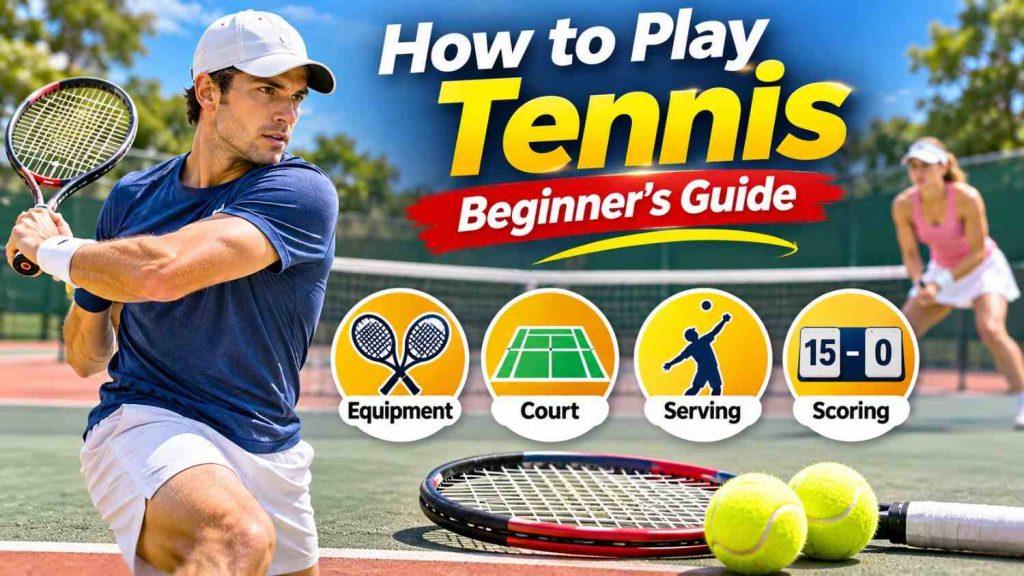
You do not need expensive equipment to begin playing tennis. A few basic items are enough to get started.
- Tennis racquet: Choose a lightweight racquet that feels comfortable in your hand. A larger head size can make it easier to connect with the ball.
- Tennis balls: Standard balls are suitable for regular play. Beginners can also use slower, low-compression balls to improve timing and control.
- Tennis shoes: Choose shoes that provide grip and support for sideways movement. Running shoes may not offer the same stability on a tennis court.
- Comfortable clothing: Wear clothes that allow you to move freely.
- Water and sun protection: Carry water, particularly when playing outdoors in warm weather. Sunscreen and a cap can also help.
If you are completely new to tennis, consider starting with slower balls. The Tennis Australia beginner programme and the ITF Play and Stay approach use different ball speeds and court sizes to help new players develop their skills.
Understand the Tennis Court Layout
A standard tennis court is rectangular and divided into two halves by a net. Each side has several lines that determine where players can serve and hit the ball.
The standard court dimensions are:
| Court measurement | Size |
| Court length | 78 feet (23.77 m) |
| Singles court width | 27 feet (8.23 m) |
| Doubles court width | 36 feet (10.97 m) |
| Net height at the centre | 3 feet (0.914 m) |
| Net height at the posts | 3.5 feet (1.07 m) |
These dimensions are the same for men’s and women’s standard tennis matches.
Important Tennis Court Lines
| Court marking | Purpose |
| Baseline | The back boundary of the court |
| Singles sideline | Marks the side boundary for singles matches |
| Doubles sideline | Marks the wider boundary for doubles matches |
| Service line | Marks the back of each service box |
| Centre service line | Divides the service area into two boxes |
| Centre mark | Helps the server position themselves behind the baseline |
Singles matches use the inner sidelines. Doubles matches use the full width of the court, including the outer lanes called alleys or tramlines.
A ball that touches any part of a boundary line is considered in.
How to Play Tennis? Step by Step
A tennis point starts with a serve. The receiving player then tries to return the ball. Both players continue hitting until one makes a mistake or fails to return the ball legally.
Follow these steps to understand how a typical point works.
Step 1: Choose Singles or Doubles
Tennis can be played in two main formats.
Singles: One player competes against another player. Both players cover their own side of the court.
Doubles: Two players form a team and compete against another pair. The full width of the court is used.
Singles can help beginners develop individual movement and shot control. Doubles is also a good way to start because you share the court with a partner.
Step 2: Learn the Basic Ready Position
Before your opponent hits the ball, get into a balanced position.
- Keep your feet around shoulder-width apart.
- Bend your knees slightly.
- Hold the racquet in front of your body.
- Keep your weight balanced on the balls of your feet.
- Watch your opponent and the ball.
This position helps you react quickly and move towards either side of the court.
Step 3: Start With a Serve
Every tennis point begins with a serve. The server stands behind the baseline and hits the ball diagonally into the opposite service box.
Here is a simple way to practise:
- Stand behind the baseline.
- Position your feet comfortably and turn your body slightly sideways.
- Hold the racquet with a relaxed grip.
- Toss the ball into the air with your other hand.
- Swing the racquet and make contact with the ball.
- Aim for the diagonally opposite service box.
You get two attempts to make a legal serve. If both attempts are faults, it is called a double fault and your opponent wins the point.
Under standard tennis rules, if the serve touches the net but lands in the correct service box, it is called a let and the serve is replayed. Some competitions may use an approved no-let format, so players should check the tournament rules.
Beginners can practise an underarm serve to develop accuracy before learning a full overhead serving motion.
Step 4: Return the Serve
The receiving player must return the serve after it bounces in the correct service box.
Stand in a comfortable position behind the baseline. Keep your knees slightly bent and watch the ball as it approaches.
Move towards the ball instead of stretching your arm too far. Try to return it over the net and inside the court.
Do not worry about hitting the ball with power. Focus on making clean contact and controlling its direction.
Step 5: Continue the Rally
A rally is the exchange of shots between players during a point.
After the serve is returned, both players try to hit the ball over the net and into the opponent’s court. You can hit the ball after one bounce or before it touches the ground.
However, the ball cannot bounce twice on your side before you return it. If it does, you lose the point.
As a beginner, aim for the middle of the court. This gives you a larger target and helps you build consistent rallies.
Learn the Basic Tennis Shots

Source Image: Thrivetennis
You do not need to learn every tennis shot immediately. Start with the main strokes and practise them regularly.
1. Forehand
The forehand is one of the most frequently used tennis shots. You hit it on the dominant side of your body.
For a right-handed player, the forehand is generally played on the right side. For a left-handed player, it is played on the left.
Turn your shoulders, prepare your racquet early and move towards the ball. Make contact slightly in front of your body and follow through towards your target.
2. Backhand
The backhand is played on the opposite side of your body. You can use one hand or both hands to hold the racquet.
Turn your shoulders as the ball approaches. Prepare the racquet and make contact in front of your body.
Many beginners find a two-handed backhand easier to control, although both techniques are useful.
3. Serve
The serve starts every point. It is also an important attacking shot because a well-placed serve can make it difficult for your opponent to return the ball.
Start by practising accuracy. Once you can land the ball in the service box consistently, work on adding speed and spin.
4. Volley
A volley is a shot played before the ball bounces. Players usually use it when standing close to the net.
Keep your racquet in front of your body and use a short, controlled movement. Avoid taking a large backswing.
5. Lob and Smash
A lob is a high shot that travels over an opponent near the net. It can give you time to recover or force your opponent to move backwards.
A smash is an attacking shot played when the ball is high above your head. Move into position, watch the ball and hit it down towards the opponent’s court.
How Does Tennis Scoring Work?
Tennis scoring is different from many other sports. Instead of counting points as zero, one, two and three, players use the terms love, 15, 30 and 40.
Tennis Point Scoring System
| Points won | Score |
| 0 | Love |
| 1 | 15 |
| 2 | 30 |
| 3 | 40 |
| 4 | Game, if the player leads by two points |
The server’s score is announced first.
For example, if the server has won two points and the receiver has won one, the score is 30 to 15.
What Is Deuce in Tennis?
When both players reach 40, the score is called deuce.
A player must win two consecutive points to win the game. The first point after deuce gives the player an advantage. If that player wins the next point, they win the game. If the opponent wins it, the score returns to deuce.
Some competitions use no-ad scoring, where the next point after deuce decides the game. Check the competition format before playing.
How to Win a Set and Match
A player usually needs to win six games with a lead of at least two games to win a set.
For example, a set can finish 6–3 or 6–4. If the score reaches 6–6, a tiebreak is commonly played.
In a standard tiebreak, the first player to reach seven points with a lead of at least two points wins. Some tournament formats use a different tiebreak format, including a 10-point match tiebreak.
Most professional singles matches are played as best of three sets. In the main men’s singles draws at Grand Slam tournaments, matches are played as best of five sets. Other Grand Slam matches are generally best of three sets, subject to the tournament regulations.
Basic Tennis Rules Every Beginner Should Know
Learn these rules before playing your first match:
- The serve must land in the diagonally opposite service box.
- A player gets two attempts to make a legal serve.
- The ball can bounce only once before it must be returned.
- A ball that touches a boundary line is considered in.
- A player loses the point if the ball lands outside the court.
- A player cannot touch the net while the ball is in play.
- A player cannot reach over the net to hit the ball before it has crossed to their side. The main exception is when the ball bounces on the player’s side and then spins or is blown back over the net.
- A return that travels around the net post rather than over the net is legal, even if it passes below the height of the net.
- Players change ends at the end of the first, third and every subsequent odd-numbered game in each set.
- During a tiebreak, players change ends after every six points.
These are the main rules for ordinary tennis. Official competitions have additional rules covering situations such as foot faults, lets and interruptions.
Tips to Improve Your Tennis Skills
Regular practice is the best way to improve. Focus on a few important habits rather than trying to master everything at once.
Practise short rallies: Ask a partner to hit gently towards you. Try to return the ball consistently.
Improve your footwork: Use small steps to reach the ball and return to a balanced position after each shot.
Work on both sides: Practise forehands and backhands. Do not rely on only one stroke.
Control your shots: Avoid hitting too hard. Aim for a comfortable target inside the court.
Practise serving: Start with a simple motion and focus on accuracy before adding power.
Play regularly: Find a friend, join a local club or arrange beginner sessions with a coach. Playing regularly helps you apply what you learn during practice.
A Simple Tennis Practice Routine for Beginners
You can build a useful practice session in around 30 minutes.
| Activity | Time |
| Light warm-up and movement | 5 minutes |
| Forehand practice | 5 minutes |
| Backhand practice | 5 minutes |
| Short rallies with a partner | 10 minutes |
| Serving practice | 5 minutes |
Adjust the routine to your fitness and experience. Take breaks when needed. If possible, ask a coach to check your grip and technique so you do not develop habits that are difficult to correct later.
Common Mistakes Beginners Should Avoid
Hitting too hard: Focus on accuracy and consistency before power.
Standing still: Move towards the ball and prepare for the next shot.
Holding the racquet too tightly: Use a comfortable grip.
Ignoring the backhand: Practise both sides of the court.
Trying advanced shots too early: Build a reliable forehand, backhand and serve first.
Not practising with a partner: Tennis is a game of movement and decision-making. Regular rallies help you learn how to respond to different shots.
Conclusion
Learning how to play tennis starts with a few basic skills. Understand the court, choose suitable equipment, learn the serve and practise your forehand and backhand. Once you understand the scoring system and basic rules, you can begin playing friendly matches.
Do not focus on winning every point when you are starting out. Build control, improve your movement and practise regularly. With time, you will become more confident and develop the skills needed to enjoy competitive tennis.
Frequently Asked Questions
Start by learning how to hold a racquet, serve the ball and return basic shots. Practise forehands and backhands with a partner. Then learn the scoring system and play short matches.
Hit the ball over the net and into the correct court area. Return it before it bounces twice. You lose the point if you fail to make a legal return, hit the ball out or commit certain rule violations.
Points are counted as love, 15, 30 and 40. A player usually needs four points and a lead of two to win a game. Six games with a lead of two usually wins a set.
Yes. You can learn basic rules, movements and shots through regular practice. However, a qualified coach can help you develop correct technique and identify mistakes.
The time depends on how often you practise and your starting fitness and coordination. You may learn basic rallies and scoring within a few sessions, but developing consistent shots and match skills takes longer.
