
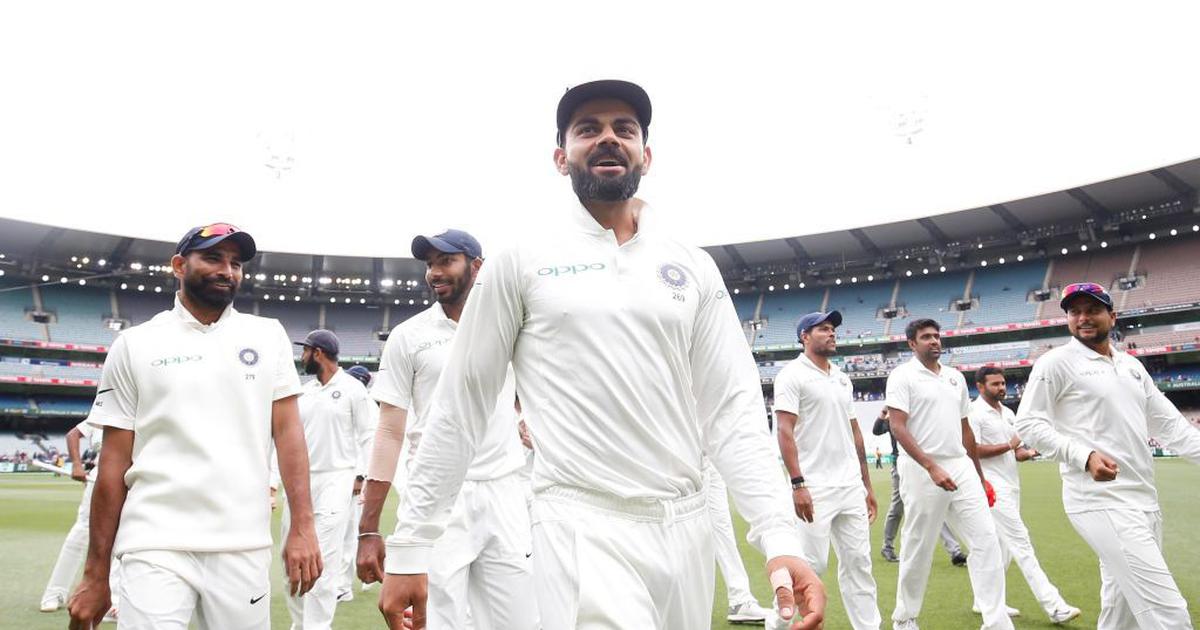
Cricket has several formats, and each tests players differently. T20 cricket focuses on quick scoring, while One Day International cricket gives teams a limited number of overs to build an innings. First-class cricket is different. It gives players several days to show their batting technique, bowling skills, patience, and consistency.
First-class cricket is one of the oldest recognised formats of the game. It includes Test matches and major domestic competitions such as India’s Ranji Trophy and Australia’s Sheffield Shield.
But what is first-class cricket, how is it played, and what makes a match eligible for this status? Here is a complete explanation of its format, rules, match duration and major tournaments.
What Is First-Class Cricket?
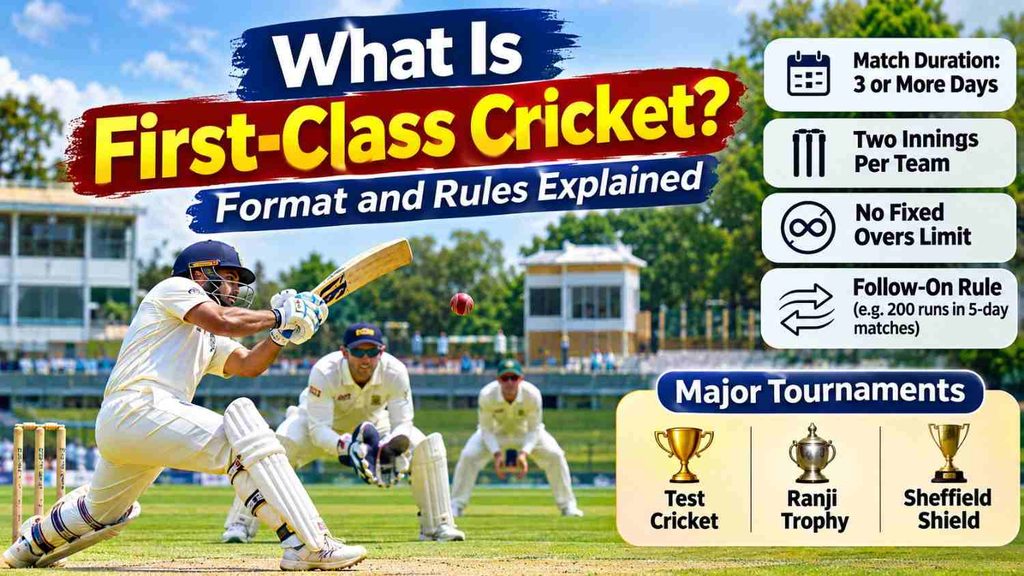
First-class cricket is an officially recognised form of the game played over three or more scheduled days. Each team has 11 players and is entitled to bat in two innings. Matches are played on natural turf pitches and must substantially follow the relevant standard playing conditions.
The ICC Classification of Official Cricket, effective from 1 July 2026, sets out the requirements for recognising first-class matches in men’s and women’s cricket.
First-class status is not automatically given to every long cricket match. The relevant governing body or the ICC must recognise the fixture. Matches involving age-group teams up to and including Under-19 cannot receive first-class status under the ICC classification.
For example, the Ranji Trophy, Duleep Trophy and Irani Cup are recognised first-class competitions in India.
The format allows teams to bat for long periods, build large totals and use different bowling strategies. It also gives players time to adapt to changing pitch conditions and plan their approach across several sessions.
How Does the First-Class Cricket Format Work?
A first-class match has two innings for each team. This means there can be up to four innings in a match.
Unlike limited-overs cricket, there is no fixed overall number of overs for each innings. A team can continue batting until it is all out, declares its innings closed or reaches another point when the innings ends under the Laws of Cricket.
Here is how the format works:
- The toss: Both captains meet before the match. The captain who wins the toss chooses whether to bat or field first.
- First innings: The team batting first tries to score as many runs as possible before its innings ends.
- Second innings: The opposition bats and tries to build a competitive total.
- Third innings: The first team gets another opportunity to bat, unless the follow-on is enforced.
- Fourth innings: The second team bats again and may have to chase a target to win.
The order can change if the team batting first enforces the follow-on. This rule allows the opposition to bat again immediately after its first innings.
A captain can also declare an innings closed before all 10 wickets fall, provided the ball is dead. However, the updated MCC Laws introduced an important restriction on declaring the final innings of a match, explained below.
How Many Days Is a First-Class Cricket Match?
A first-class match must be scheduled for at least three days. Many domestic competitions use three- or four-day matches, while men’s Test cricket is generally scheduled for five days.
| Match format | Usual duration | Example |
| Three-day first-class | 3 days | Selected domestic competitions |
| Four-day first-class | 4 days | Ranji Trophy |
| Five-day first-class | 5 days | Test cricket |
Rain, bad light, interruptions, and other conditions can affect actual playing time. A match may finish before its scheduled final day if a team wins early.
There is no fixed limit on the total number of overs in a first-class match. This is one of its biggest differences from List A and T20 cricket.
What Are the Main Rules of First-Class Cricket?
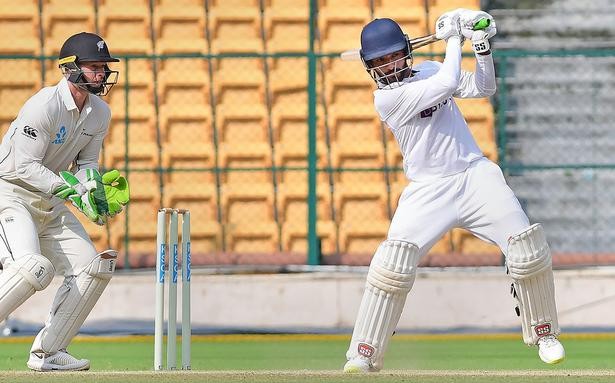
Source Image: Cricheroesapp
First-class cricket follows the Laws of Cricket and the relevant competition playing conditions. Some important features include:
1. Two Innings Per Team
Each side normally has two opportunities to bat. A team can score runs in both innings, and its total match score is the combined runs from both innings.
2. No Fixed Overs Limit
Unlike limited-overs cricket, first-class teams are not restricted to 50 or 20 overs per innings. The innings continues until it ends under the Laws or the captain declares, subject to the applicable playing conditions.
3. Follow-On Rule
The follow-on is an option available to the team that bats first. If it builds a sufficiently large lead after both first innings are completed, its captain can ask the opposition to bat again immediately instead of taking the team’s second innings.
The minimum lead depends on the scheduled length of the match:
| Scheduled match duration | Minimum first-innings lead |
| 5 days or more | 200 runs |
| 3 or 4 days | 150 runs |
| 2 days | 100 runs |
| 1 day | 75 runs |
The one-day threshold is included for completeness under the general follow-on Law; first-class matches themselves must be scheduled for at least three days.
The follow-on is not automatic. The captain of the team batting first decides whether to enforce it after reaching the required lead. If no play takes place on the first day, the applicable threshold may change according to the number of days remaining when play begins.
4. Declaration
A declaration happens when the batting captain voluntarily closes an innings before all 10 wickets fall. It is usually used to give the bowling team enough time to dismiss the opposition and secure a result.
Under the MCC Laws of Cricket 2017 Code, Fourth Edition, which came into force on 1 October 2026, a captain cannot declare the final innings of a match. A captain also cannot forfeit the final innings before it begins.
A declaration can be made when the ball is dead, subject to the applicable playing conditions. Competition rules may modify or replace the standard Laws, so the relevant tournament regulations should also be checked.
5. Draws and Ties
A first-class match can end in a win, loss, draw or tie.
A draw usually occurs when the scheduled time runs out before either team achieves an outright victory.
A tie is different. It happens when both teams have the same total score after all relevant innings have been completed.
Is Test Cricket the Same as First-Class Cricket?
Source Image: Cricheroesapp
No. Test cricket and first-class cricket are closely connected, but they are not the same category.
Test cricket is an international format played between representative teams of ICC Full Members under official Test playing conditions. First-class cricket is a wider category that also includes recognised domestic matches.
Every Test match is classified as first-class. However, domestic first-class matches are not automatically Tests.
| Feature | Test cricket | Domestic first-class cricket |
| Level | International | Domestic and other recognised competitions |
| Teams | National representative teams | State, provincial, county or other recognised teams |
| Innings | Two per team | Two per team |
| Duration | Generally 5 scheduled days | 3 or more scheduled days |
| Example | India vs Australia Test | Ranji Trophy match |
For example, a Test between India and Australia is both a Test match and a first-class match. A Ranji Trophy match between Mumbai and Karnataka is first-class cricket, but it is not a Test.
First-Class Cricket vs List A vs T20 Cricket
First-class, List A and Twenty20 are separate official classifications of recognised cricket. Their rules and match lengths are different.
| Feature | First-class | List A | T20 |
| Match duration | 3 or more scheduled days | Usually 1 day | Usually 1 day |
| Innings per team | 2 | 1 | 1 |
| Overs limit | No fixed overall limit | Usually 50 | 20 |
| Main focus | Technique and endurance | Balanced scoring and bowling | Fast scoring |
| International example | Test | ODI | T20I |
| Indian domestic example | Ranji Trophy | Vijay Hazare Trophy | Syed Mushtaq Ali Trophy |
List A cricket is the recognised limited-overs category for one-day matches at the required level. It includes One Day Internationals and recognised domestic one-day competitions. The standard classification requires at least 40 scheduled overs per side, although a match can retain its List A status if weather reduces the available overs.
T20 cricket has its own separate classification. It is not simply another type of List A cricket. International T20 matches are classified as T20 Internationals, while domestic competitions must meet the relevant recognition requirements to receive official T20 status.
The ICC maintains separate classifications for these formats. A match does not become first-class simply because it lasts several days. It must meet the official requirements and receive the correct status.
Major First-Class Cricket Tournaments Around the World
Several countries organise domestic first-class competitions. These tournaments give players regular opportunities to compete in multi-day cricket and develop the skills required for Test matches.
| Tournament | Country |
| Ranji Trophy | India |
| Duleep Trophy | India |
| Irani Cup | India |
| County Championship | England |
| Sheffield Shield | Australia |
| Plunket Shield | New Zealand |
| Quaid-e-Azam Trophy | Pakistan |
| National Cricket League | Bangladesh |
| Bangladesh Cricket League | Bangladesh |
| CSA 4 Day Series | South Africa |
| West Indies Championship | West Indies |
| Logan Cup | Zimbabwe |
India has a strong domestic first-class structure. The Ranji Trophy is its leading state-level championship. The Duleep Trophy features zonal teams, while the Irani Cup is played between the Ranji Trophy champions and the Rest of India.
These competitions help selectors assess players over longer periods rather than judging them on a few short performances.
Why Is First-Class Cricket Important?
First-class cricket plays an important role in developing professional cricketers. It tests skills that players need at the highest level.
- Batting technique: Batters must concentrate for long periods and learn to build an innings. They face different bowling attacks and changing pitch conditions.
- Bowling control: Bowlers need patience, accuracy and stamina. They often have to create chances over several spells rather than rely on a short burst of overs.
- Fitness and concentration: Playing across several days requires physical preparation and mental strength. Players must remain focused even when the match moves slowly.
- Match awareness: Captains and players must understand when to attack, defend, declare or enforce the follow-on. Decisions can affect the result over several sessions.
- Pathway to Test cricket: Domestic first-class performances help selectors identify players who can handle the demands of international red-ball cricket.
Conclusion
First-class cricket is the traditional multi-day format that tests a player’s technique, patience, fitness and tactical understanding. Each team has two innings, and matches must meet the official requirements to receive first-class status.
Test matches, the Ranji Trophy, County Championship and Sheffield Shield are important examples. The format remains a major part of cricket because it gives players the time and challenge needed to develop skills for the highest level of the game.
Frequently Asked Questions
First-class cricket is an officially recognised multi-day format in which two teams of 11 players each get two innings to bat. Matches must be scheduled for at least three days and meet the relevant classification requirements.
There is no fixed overall overs limit for a first-class innings. A team can continue batting until it is all out, declares or its innings ends under the Laws of Cricket and the applicable playing conditions.
Yes. The Ranji Trophy is India’s leading domestic first-class competition. It is played between state teams under a multi-day format.
Yes. A match can end in a draw if the scheduled time finishes before either team secures an outright win. It can also end in a tie if both teams finish with equal scores after the required innings.
It can be scheduled for three or more days. Many domestic competitions use three- or four-day matches, while men’s Test cricket is generally scheduled for five days.
