
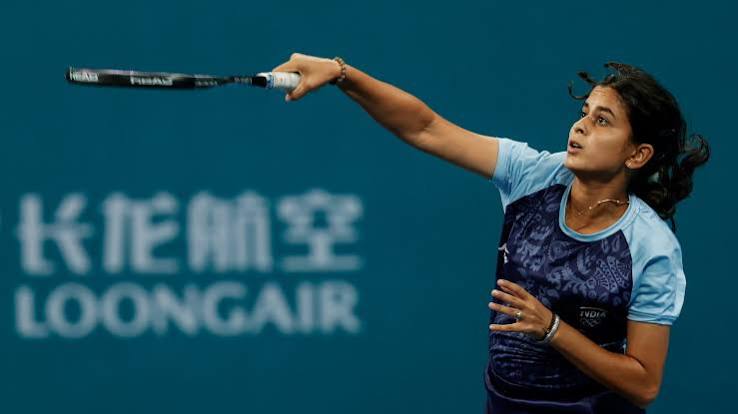
Soft tennis is a racket sport that looks similar to traditional tennis but uses a softer, lighter rubber ball. It originated in Japan in 1884 and developed as a separate version of lawn tennis. Players hit the ball over a net and try to land it inside the opponent’s court.
The main difference is the equipment. Soft tennis uses an air-filled rubber ball instead of the familiar felt-covered tennis ball. This changes how the ball moves, bounces and responds to spin. The sport also has a different scoring system, although several basic rules are similar to conventional tennis.
Soft tennis is particularly popular in Japan and other Asian countries, including South Korea, Taiwan and India. It is played in singles, doubles and mixed doubles. Doubles has traditionally been a popular format.
What Is Soft Tennis?
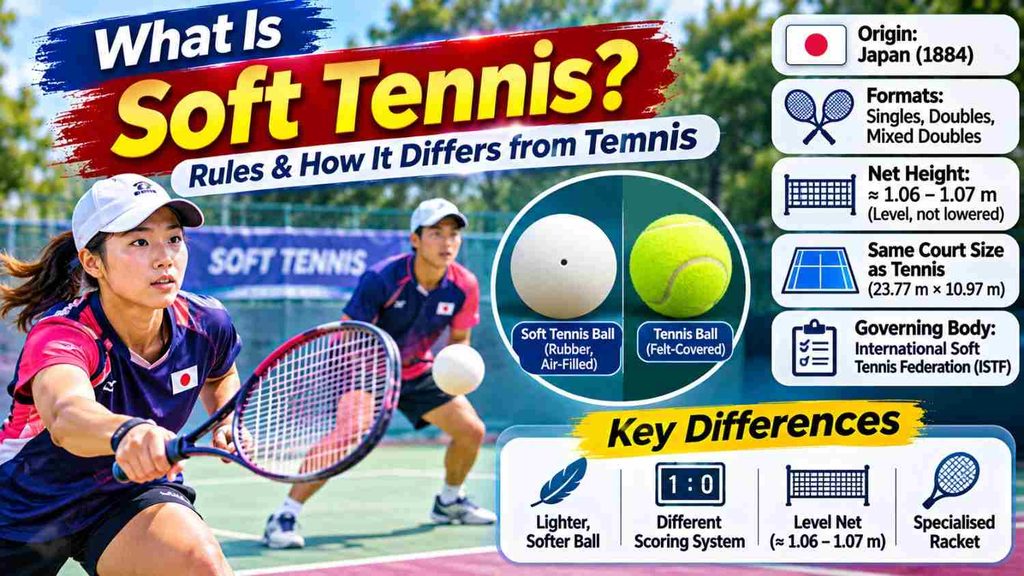
Soft tennis is a racket sport in which two players or two pairs compete on opposite sides of a net. The aim is to hit the ball into the opponent’s court in a way that makes it difficult to return.
The sport uses a hollow, air-filled rubber ball. It is lighter and softer than a standard tennis ball. Players also use rackets designed to suit the ball’s characteristics.
Soft tennis follows many familiar tennis principles. Players serve, rally, score points and try to win games. However, the ball, racket specifications, scoring format and net arrangement make it a distinct sport.
The International Soft Tennis Federation (ISTF) governs the sport at international level. It oversees international competitions and publishes the technical rules used in organised matches.
History and Origin of Soft Tennis
Soft tennis originated in Japan in 1884. Traditional lawn tennis had reached the country from the West, but standard tennis equipment was expensive and difficult to obtain. Japanese players began using rubber balls as an alternative to conventional tennis balls.
This adaptation gradually developed into a distinct sport known as soft tennis. It became popular in schools, universities and local sporting communities.
Here are some important dates in its development:
| Year | Important development |
| 1884 | Soft tennis originated in Japan using rubber balls |
| 1924 | Japan’s national soft tennis governing organisation was established |
| 1973 | International Soft Tennis Federation was established |
| 1975 | First World Soft Tennis Championships were held in Hawaii |
| 1990 | Soft tennis appeared as an exhibition sport at the Beijing Asian Games |
| 1992 | Japan changed the sport’s name from soft-style tennis to soft tennis |
| 1994 | Soft tennis became an official Asian Games medal sport |
| 2000s | Soft tennis expanded its presence in Europe |
The International Soft Tennis Federation was established to promote the game and improve cooperation between national associations. Its international competitions helped the sport reach more countries.
Soft tennis has continued to develop beyond Japan. Asian countries have played an important role in its growth, while clubs and national organisations have introduced it to players in Europe and other regions.
Equipment Used in Soft Tennis
Soft tennis requires a racket, a rubber ball, a net and a suitable court. The equipment is similar to conventional tennis, but there are important differences.
1. Soft Tennis Ball
The ball is the most noticeable difference. A standard soft tennis ball is hollow, made from rubber and filled with air. It does not have the felt covering found on conventional tennis balls.
According to ISTF technical rules, the ball has the following specifications:
- Weight: 30 to 31 grams
- Diameter: 6.5 to 6.7 centimetres (6.6 cm ± 0.1 cm)
- Material: Rubber
- Bounce: 70 to 80 centimetres when dropped from 1.5 metres
- Standard colour: White
Players can adjust the air pressure using a suitable pump. The pressure affects how the ball feels and behaves during play.
The lighter ball responds well to spin. It can also be affected more by wind than a conventional tennis ball.
2. Soft Tennis Racket
Soft tennis rackets look similar to regular tennis rackets. However, they are designed to work with the lighter rubber ball.
They can have different frame materials, shapes and weights under ISTF rules. Their strings and tension are selected to suit the ball and the playing style.
Players use these rackets to generate speed, spin and control during rallies.
3. Court and Net
Soft tennis uses a court with the same basic dimensions as a conventional tennis court. The doubles court measures 23.77 metres long and 10.97 metres wide. The singles court is 8.23 metres wide.
The net is another important difference. In soft tennis, it remains level across its full length rather than being lowered in the centre as in conventional tennis.
The official net height is approximately 1.06 to 1.07 metres. This level arrangement distinguishes it from the conventional tennis net, which is lower at the centre.
Soft Tennis Rules Explained
The basic objective is to win points by hitting the ball into the opponent’s court. A player or pair must return the ball before it bounces twice.
Soft tennis has rules for serving, receiving, scoring and changing sides. The main principles are easy to understand for anyone familiar with tennis.
1. Players and Match Formats
Soft tennis can be played in several formats:
- Men’s singles
- Women’s singles
- Men’s doubles
- Women’s doubles
- Mixed doubles
- Team competitions
Doubles is especially popular. Each pair has two players, and both players take part in the match according to the serving and playing order.
2. Serving Rules
A point starts with a serve. The server stands behind the baseline and hits the ball into the diagonally opposite service court.
In doubles, the two players in the serving pair take turns serving for two consecutive points when it is their turn to serve. The serving order must follow the competition rules.
A serve is considered a fault if the ball does not land in the correct service court or the server commits another serving violation. Players receive a second serve after a first fault. Two consecutive service faults result in the loss of the point.
3. Rally Rules
After a successful serve, both sides try to return the ball over the net.
The ball must land inside the opponent’s court. Players can use different shots, including forehands, backhands, smashes and volleys.
A player or pair loses the point if they fail to return the ball legally, hit it out or allow it to bounce twice before returning it.
4. Scoring System
Soft tennis uses numerical scoring, with points counted as 1, 2, 3 and 4 instead of 15, 30 and 40. A normal game is won by the first player or pair to score four points.
If both sides reach three points, the score becomes deuce. A player or pair must then win two consecutive points to take the game.
Singles matches are generally played over seven games, while doubles matches can use seven or nine games, depending on the competition format.
In the deciding game, the first side to reach seven points wins the game and the match. If the score reaches 6–6, the deuce procedure applies.
| Scoring stage | Soft tennis |
| First point | 1 |
| Second point | 2 |
| Third point | 3 |
| Fourth point | Wins the game, if the opponent has fewer than 3 |
| Both sides reach 3 | Deuce |
| After deuce | A side must win two consecutive points |
| Deciding game | First to 7 points, subject to the deuce rule |
The exact match format can depend on the competition’s regulations.
Soft Tennis vs Regular Tennis: Key Differences
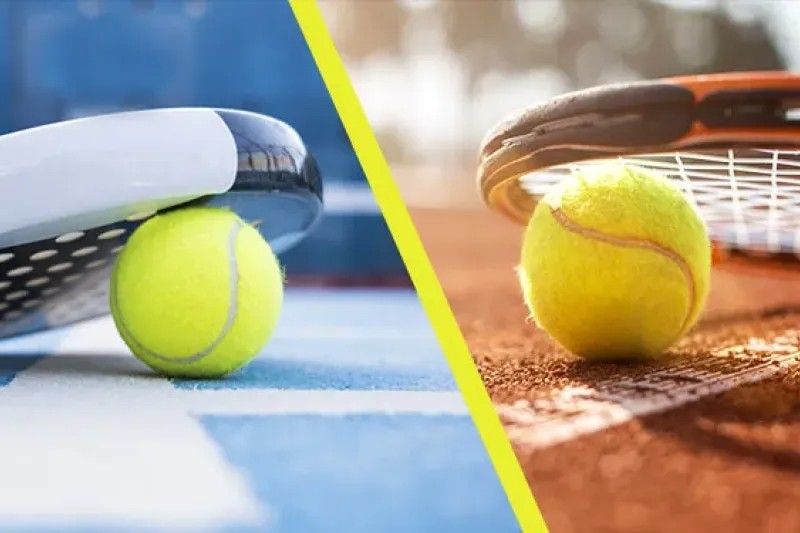
Source Image: padelmagazine
Soft tennis and conventional tennis share the same basic objective. Both involve hitting a ball over a net and trying to make it land inside the opponent’s court.
However, the equipment and scoring systems create a different playing experience.
| Feature | Soft Tennis | Regular Tennis |
| Ball | Hollow rubber ball | Felt-covered ball |
| Ball weight | 30 to 31 grams | Approximately 56 to 59.4 grams |
| Ball diameter | 6.5 to 6.7 cm | Approximately 6.54 to 6.86 cm |
| Racket | Designed for a lighter rubber ball | Designed for a heavier tennis ball |
| Court size | Standard tennis court dimensions | Standard tennis court dimensions |
| Net | Level across its full length | Lower in the centre |
| Scoring | 1, 2, 3 and 4 | 15, 30, 40 and game |
| Popular format | Doubles is particularly popular | Singles and doubles |
| Origin | Japan, 1884 | Modern lawn tennis developed in Britain |
The biggest difference is the ball. A soft tennis ball is much lighter and has no felt covering. It can take considerable spin and react differently to the playing surface and wind.
The scoring system also makes soft tennis easy to distinguish. Conventional tennis uses 15, 30 and 40, while soft tennis counts points numerically.
Major Soft Tennis Competitions
Soft tennis has national, regional and international competitions. These events give players opportunities to compete in singles, doubles, mixed doubles and team formats.
Some of the important competitions include:
World Soft Tennis Championships
The World Soft Tennis Championships are among the sport’s major international events. National teams and players compete for world titles in different categories.
The first World Soft Tennis Championships were held in Hawaii in 1975. The ISTF organises and oversees the international championship structure.
Asian Games
Soft tennis has been an official medal sport at the Asian Games since 1994. It first appeared as an exhibition event at the 1990 Beijing Asian Games.
Japan, South Korea and other Asian nations have a strong presence in the competition.
At the 2026 Aichi-Nagoya Asian Games in Japan, soft tennis continued as an official medal sport. India’s Jay Meena made history by winning bronze in the men’s singles event. He became the country’s first-ever Asian Games medallist in soft tennis. The achievement marked an important milestone for the sport in India.
Asian Soft Tennis Championships
The Asian Soft Tennis Championships bring together players from different Asian countries. The event provides an important platform for regional competition and helps develop the sport across the continent.
National and School Competitions
Japan has a strong domestic soft tennis structure. Schools, universities and local clubs organise competitions that help young players develop their skills.
The sport is also played through national associations and clubs in other countries.
Is Soft Tennis Easier Than Regular Tennis?
Soft tennis can be easier to approach for some beginners because its ball is lighter and its racket is designed for that ball. The numerical scoring system is also straightforward.
However, this does not mean that soft tennis is an easy sport at competitive level. Players need good footwork, timing, stamina and ball control.
The rubber ball can produce significant spin and change direction after bouncing. Wind can also affect its flight. Players must learn to adjust their shots and positioning.
Anyone who already plays conventional tennis may find the transition easier because the court layout and many basic techniques are familiar.
Conclusion
Soft tennis is a racket sport that originated in Japan in 1884. It shares the basic structure of conventional tennis but uses a lighter, air-filled rubber ball and a different scoring system. The court dimensions are similar, while the net remains level across its full width.
Doubles is a popular format, and the sport has developed through international championships and the Asian Games. Its growth was also highlighted at the 2026 Aichi-Nagoya Asian Games, where India’s Jay Meena won a historic bronze medal in men’s singles. This achievement brought greater attention to soft tennis in India.
Its combination of familiar tennis skills and distinctive equipment makes soft tennis an interesting alternative for beginners and experienced racket sport players.
Frequently Asked Questions
Soft tennis is a racket sport that uses a hollow rubber ball instead of a felt-covered tennis ball. Players compete in singles or doubles and try to hit the ball into the opponent’s court.
Soft tennis originated in Japan in 1884. It developed from conventional lawn tennis after players began using rubber balls as an alternative to expensive imported tennis balls.
The main differences are the ball, racket setup, net arrangement and scoring system. Soft tennis uses a lighter rubber ball and counts points as 1, 2, 3 and 4. Regular tennis uses a felt-covered ball and the 15, 30 and 40 scoring system.
Soft tennis can be played by two players in singles or four players in doubles. Mixed doubles is also played, with one male and one female player in each pair.
No. Soft tennis is not currently an Olympic medal sport. However, it is an official medal sport at the Asian Games and has its own World Soft Tennis Championships.
